A New Kind of Blog

There is a world of information about Ecuador. It is one of the most popular countries for people who want to retire to a place where the dollar goes much farther than in the US, a place for adventuresome families who want to experience a new language and exciting culture. However, much of what you read or hear does not touch on the practical, the problematic, or the local information necessary to make things work. There are many blogs which are basically daily diary’s from people who live here. But this blog will be different. We know how hard it is to get accurate and timely information. We have been through it. All of us who live here have learned step by step and we question whether it is necessary to have every newcomer reinvent the wheel. We hope this blog will help shorten the learning curve. There are many hurdles but all are surmountable. What is required is patience, an understanding of local ways, and a realization that you are going to live in a country which is not the same as the US, Canada, or Britain. Our choice was to live in the wonderful city of Cuenca in the Southern Sierra but this may not be your decision and you will therefore have to look further to find the answers you need for different areas like the coast or the Amazon. Please realize that all the suggestions and ideas are based on our experiences. Ecuadorian regulations change rapidly and must be checked before you make any investments or major decisions. Please email us at Sailorburr@gmail.com and let us know if you have any questions or comments.

Friday, June 25, 2010

Wherever you go, there you are


We’re back after six weeks in the states and want to thank all the people who wrote emails and asked if we were OK as we had not posted anything for many weeks. We are fine, just a little exhausted from living in a suitcase for weeks on end.  The culture shock was, however, palpable. It felt very strange to hear English spoken by almost everyone but that certainly made everyday transactions in the US at the stores and on the phone much easier. It was interesting to hear the background babel in English rather than Spanish. The high ticket prices of almost everything were expected but we had really forgotten what a dramatic difference there is between Cuenca prices and the US.  In the year and a half we have lived in Cuenca and gotten used to the prices here, we have found that we are concerned when a taxi driver tries to extract $2.50 instead of the $2.00 that we know the ride is worth. We have become used to buying local brands at the market rather than imported products and saving 20 cents here, 50 cents there.  And we had changed our diet to almost all fruits and vegetables. In the last year, we had adjusted to the local economy.  But, when we started shelling out, what to us, were huge amounts of money for things we had become used to at a lower price, it was quite a shock.  We did make quite a few purchases of items that are hard to get in Ecuador, enough to necessitate the purchase of a new suitcase to hold all of them. We brought back several things for friends which is an excellent way to avoid the high cost of shipping new items. Almost everyone here makes a special point of asking friends if they need anything that can be brought back in a suitcase.  The visit to Best Buy and Costco made us feel like kids in a candy store.


There are a few ways to fly from the US to Cuenca which of course depends on where in the States you originate but for those of you who are on the east coast and planning a visit to Cuenca we can offer some up-to-the-minute information. Miami and Atlanta are the main departure points for either Quito or Guayaquil, the only international airports in Ecuador. We flew Delta out of Guayaquil to Atlanta then on to North Carolina. Guayaquil airport is quite modern and large. If your connection takes many hours, there is a baggage storage area on the first floor. We had 12 hours in Guayaquil so the storage company was a big help. Atlanta is a zoo and is the busiest airport in the world according to Delta’s information. You need a good hour or two there as almost all connecting flights are in different terminals requiring a train ride between terminals. We made our return to Ecuador from Atlanta to Quito. The airport in Quito is quite antiquated with few amenities probably because the new airport outside of town is almost complete yet has had a year long delay in opening.  The old airport is right downtown and makes for a hairy approach on landing as you skim over roof tops toward a rather short runway.  Depending on what cab driver you get in Quito, a taxi ride to the old part of town is about 12 dollars. We spent the night in Quito as almost all flights arrive late in the evening after the local airline connections to Cuenca have ended for the day.  The three best local airlines to and from Cuenca and either Guayaquil or Quito are AeroGal, Lan Ecuador, or Tame. Between the three airlines there seems to be a flight to Cuenca almost every of the daytime hours but they end around 7 PM which is the reason for the need for an overnight stay.
We are glad to be back as Cuenca feels like home to us now.  But, as the sage said, “Wherever you go, there you are.”

Tuesday, May 4, 2010

The Sky Over Cuenca

We are constantly amazed at the sky over Cuenca and have never lived anywhere that provided such dramatic shifts in the weather hour by hour. Though the following photos were not all taken on the same day, they are an example of what a typical afternoon and evening can be like. 


Photographers in Cuenca are almost always looking up at the clouds overhead where the intense sunlight causes a dramatic contrast between the clouds and the deep blue sky. This sharp contrast is a photographer's dream. Sometimes clouds reach down into the mountain valleys creating a constant surprise that totally changes the landscape.  The above photo is typical of a bright sunny day. 


Late in the afternoon, it is common for a rainstorm to sweep across the city. This one was unusual because the sky was black behind the city still illuminated in sunlight. 


The afternoon storm clears and early evening presents a constantly changing and often colorful hour. 


Sunset. What more can we say? It often seems like an inferno is roaring behind the mountains


The sun is gone and purple glows behind the clouds. Then darkness falls over the city until tomorrow when a whole new series of changing weather blows over the mountains. All of these photos were taken from the windows of our apartment in town, a never ending panorama. 

Monday, April 26, 2010

The Indigenous People of Cuenca

Most of the indigenous Indians of Ecuador who are women wear colorful clothing consisting of Panama hats, long breaded hair, and velvet pleated skirts that are embroidered with distinct village designs. With the exception of tourist places, these are not costumes but the clothing they wear every day. The men rarely wear indigenous clothing except those men who live in the outlying villages. 


These two women are perfect examples of the clean, neatly dressed Indian women of Cuenca. Though probably quite poor, they dress as well as they can.  


A sight we never get used to is the huge loads women carry on their backs, bent over with only a strap holding the sack against her back, she may walk a mile to her destination. 


It is not a frequent sight to see a small child dressed as their parents. Most children we see are in school uniforms or in regular pants and shirts. 


Another woman carrying an imense load on her back. You will notice that a hat or shawl is almost always worn over the head to protect them from the intense sunlight. 


This woman is shopping at a store that specializes in saddles and other horse related gear.


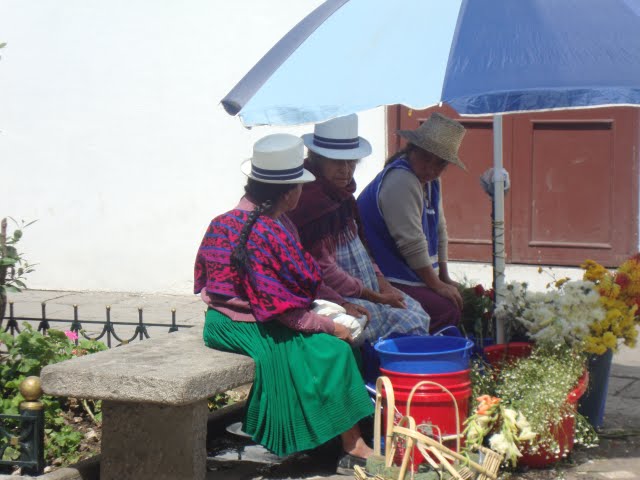
These three women at the flower market are having a chat. Just around the corner are a dozen stalls selling every flower imaginable for almost nothing. 


An old woman, at least it looks that way. She might be 50, 60, 70, 80 or more. There is no way to tell as a life time of hard work ages Ecuadorian Indian women rapidly. It is a rainy afternoon and she has covered her hat with a plastic bag.


We see this very old woman almost every time we walk into town. We see her in Centro and then, an hour later, find she has walked miles to the another part of town. Walking and hard work may be the answer to the long life we see among so many of the indigenous Indian women in Cuenca. 


Saturday, April 24, 2010

The Latin sense of personal space


We are basically a typical American family when it comes to privacy and are quite like most other North Americans who have an acutely defined sense of personal space. Possibly this sense of personal space can be better phrased as, “please keep your distance.” Though it is not terribly admirable, we are conscious of how close we stand to another person, our body language, how we present ourselves in public, eye contact, and a host of other rather puritanical behaviors that date back to our childhood educations. Though this zone of protection is not unique in the world, it is certainly honed to perfection in the US. One of the early shocks a North American gets when arriving in a Latin country like Ecuador is the almost complete loss of personal privacy or space. This posting is in no way a criticism only an observation of Latin behavior that is often subtle and at other times absolutely blatant.  Some of the challenges to a North American’s sense of personal space are easy to accept. Others will take a little time.
Kissing strangers – One of the nicest customs in Ecuador is the way men and women kiss each other on the cheek when they are introduced and on greeting each other whenever they meet again. We have even seen some men, often family members, who will buss each other on the cheek on greeting.  Children, and even more amazingly, teenagers will give you a welcoming kiss on the cheek. This seems so much nicer than the cold, very formal handshake.
Public display of affection – you will often see young men and women embracing on a street corner or leaning up against a wall locked in a kiss, with no concern about who might be watching. In the parks, you might find an older couple laying on the grass, unselfconsciously huddled next to each other, the man asleep and his wife shading his face with her arm or a magazine.  Elderly couples often walk holding hands. Women walking together will almost always stroll by arm in arm. It is a sense of public affection North Americans are not used to.
Erotic advertising – much of the TV, newspaper, and magazine advertising is like that in Europe with considerable nudity and erotic posing and not subject to the censorship imposed in the US.
Dressing – Except for lawyers, doctors and some officials and business men, the dress code for those of us in Cuenca is quite casual. We rarely “dress up” when we go out for dinner even in the finest restaurants. However, most men are well attired. Only a few wear sneakers or non-collared shirts. Women rarely wear dresses and most of the time wear tight jeans or slacks, high heels and are much less puritanical about cleavage than the average American.  Unconcerned by body size or age, Cuenca women appear to make a great effort to look stylish.
Staring – It takes quite a while to get used to the way Ecuadorians stare directly at you and often do not look away when you look back at them. Whether it is because of most gringos’ Caucasian appearance or our way of dressing, people tend to make long staring observations of us.
Picking up a child – An Ecuadorian would never ask if it is all right to reach down and pick up your child.  It would not dawn on them that the child might be afraid of a stranger or has been told to be cautious with a person they do not know.  Ecuadorian children are usually very shy and absolutely obedient to their parents and teachers. Ecuadorians therefore don’t even think that the child might be concerned or afraid.
Strangers reading your document – if you are standing in line reading something, people nearby will lean over to try to see what you are reading.  If you frown at them for reading your document, you most often get a look of complete misunderstanding of why you are frowning.
ATM’s – There is no yellow line 15 feet back from the ATM machine like in the US. While you stand in front of the machine taking out your money, the next person in line will often stand only a few feet behind you.
Standing in line – On many occasions, when you are standing in line at the bank or any other crowded place, people will push and try to get in front of you.  As a contradiction, older people are supposed to be allowed to go to the front of the line without waiting.
Neatness – Most Ecuadorians are meticulous in their personal cleanliness. Workers always change from street clothes into work clothes when arriving on the job and wash their hands and faces, wet down their hair, and change back to street clothes before they leave.  It is a rarity to see a disheveled person and we have yet to run into someone who “smells bad.”
Public Urination – It is always a surprise to see a man relieving himself on the street against a wall, a store front, or a tree. No one seems to notice or care.
Rude driving behavior - Cutting you off, passing on wrong side, honking as the traffic light turns yellow, racing to get ahead of you, are all symptomatic of the Ecuadorian driver’s ethic. It is road rage at its zenith but there is no rage. If you give them a dirty look for some infraction of what you might call proper driving behavior, you get a surprised look in response. “What did I do wrong?” is the facial expression.
Security – A touchy subject that we all don’t agree on.  Personal security on the street is quite important and everyone should follow the proven advice of staying alert to potential thieves, not wearing expensive looking jewelry, holding purses close to your body, and not carrying camera’s or cell phones where they can be easily snatched.  In a poor country like Ecuador, these items represent enormous wealth to some.  Whatever the financial status of our gringo friends, just the fact that they are gringos sends out the message that they are rich and will be carrying expensive items.  This is personal space that we too often take for granted as secure. 

Wednesday, April 21, 2010

A drive into the Cajas National Park

We received such a positive response to our posting of  A walk in town that we thought you might enjoy a similar drive up into the mountains beginning just outside Cuenca and on up into the Cajas National Park. Though only about 25% of our friends own a car, we chose to have a vehicle to take on weekend jaunts like this into the mountains, often just roaming the steep, dirt roads to soak up unique, out-of-the-way, Ecuadorian culture.


Above is a view from our apartment up into the Cajas National Park. After a short drive through town, past the cluster of high rise apartment buildings mainly occupied by the expat community, then up and on through one small village after another until we are in a beautiful, wild countryside.


From the road side, we couldn't resist taking a photo of these cattle sillouetted against the horizon. 


Then around the next bend there were horses grazing on the lush straw grass


After about 20 km or so, a left turn off the highway and down a long, winding dirt road, passing many trout ponds and rushing streams, we arrive at our favorite restaurant, Dos Chorreros. We have spent many happy birthdays, Christmas days and holidays having dinner here on trout raised in their mountain stream fed ponds. 


A view from the restaurant up into the higher country where there are almost no trees. The restaurant is at about 12,000 feet elevation.


After a huge dinner, we often hike up this narrow, gravel road past strange perpidicular trees called Puya Bromeliades, a hairy flowered spike surrounded by wool.  Orange, licen covered rocks and wild flowers are everywhere. Though we are almost on the equator, at this altitude it can be cold enough that we usually wear parkas and hats. Back in Cuenca, 30 km away, people are in T-shirts. About 10 km beyond the restaurant, the highway comes to a control point where we enter the Cajas National Park


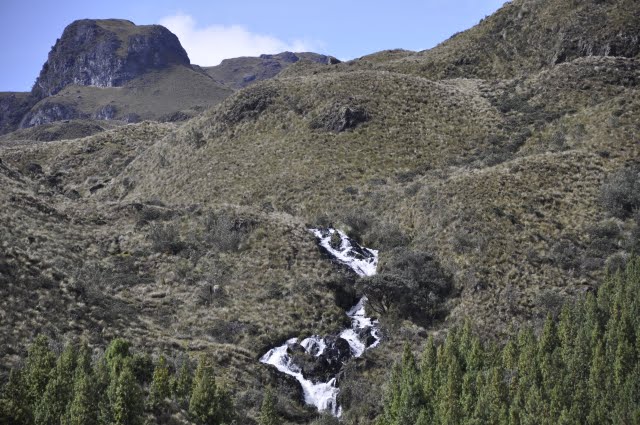
One day, we will find our way up to these waterfalls that tumble down from the high country. . 


One of the 250 sparkling, clear lakes in the park that are favorite haunts for trout fishing. These lakes and the mountain rivers provide 60% of Cuenca's drinking water reputed to be the best in Ecuador. 


Alpaca's roam the rocky terrain nibbling on the lush growth. The narrow road in the background from this point on heads down the west side of the Andes toward Guayaquil. It is actually the main road from Cuenca to Guayaquil followed by the busses and limos, a winding, harrowing trip for anyone. At this point we are on the Continental Divide where all the water on the west slope of the Andes falls to the Pacific Ocean and all the water on the East slope travels 1000 miles through the Amazon before emptying into the Atlantic Ocean. 


Far above the tree line, the lunar landscape is like being in another world. Depending on where you go in the Cajas National Park, you will see barren, volcanic outcropings like this, cloud forests, farm land, grazing animals, hundreds of fishing lakes, waterfalls, and more in a constantly interesting panorama. Cajas is a natural wonderland worthy of deeper penetration than just a dive in the car. 

Sunday, April 18, 2010

Careful – the sun is strong

         
It is too easy to forget that Cuenca is nearly on the Equator and at approximately 8500 feet in elevation nestled in the Andes Mountains. Those of you who have skied at high altitudes in America’s west or the European Alps already know how strong the sun can be. Though the temperatures in the mountains of the US and Europe can often be freezing, skiers will have their nose and cheeks covered with a protective zinc oxide cream to stave off the sun.  Add to that, the fact that the sun in Cuenca is directly overhead because we are almost directly on the Equator and you have come up with a powerful combination of UV rays raining down on you year round. On a day like in the photo, the sun can be deceptive. 
Our dermatologist at Monte Sinai Hospital has warned us to take precautions as Cuenca has the highest level of skin cancer incidences in all of Ecuador. While we are never as diligent as we could be, we wear sunscreen cream on our uncovered faces and arms. Loretta and Jonny being redheads often wear hats. An excellent choice of sunscreen in both gel and cream form is a local product appropriately named Umbrella. It can be purchased without prescription at any pharmacy.  On a bright, sunny day, it is quite common to see people walking with an open umbrella or holding a magazine or newspaper over their heads to keep out of the sun. Many people also wear wrap-around sunglasses, as the sun not only bears down with harmful UV rays, but it is also extremely bright to the point where it can actually hurt your eyes. Fortunately, you will find street salesmen almost everywhere loaded down with sunglasses for sale at around $12 and up. So, covering your arms, applying sun lotion to your face and exposed arms, wearing hats and sunglasses are all good protective precautions. We have seen too many visitors with bright red faces from painful sunburns who walked through town on a sunny day or even on a cloudy day not realizing how quickly they can be hurt by the sun. It takes only one experience like this to make a believer. 

Friday, April 16, 2010

Working hours

There is a distinctly European concept in Ecuador about the day’s work and school hours. Most businesses open between 9 and 10 am then close between 1 and 3 pm so the proprietor and employees can leave for an extended meal at home. They then return to work at 3 pm and the establishment will stay open until 7 or 8 in the evening. There are some exceptions to this schedule like the Supermaxi markets, pharmacies, and gas stations which are open early and close late. You will find little auto or walking traffic on the streets during the luncheon hours when almost everyone goes home for the traditional, main meal of the day. After 8 pm most families have a light supper at home, often as little as a sandwich. Medically this has to be a more beneficial approach to eating than the typical North American heavy dinner which is hard to digest so close to bedtime.  As a contradiction to this healthy supper, restaurants usually serve large meals for much less money than in the US or Europe. They generally open about 7 pm and are almost empty (except for gringos) until 9 pm when many families abandon the concept of the light supper and go out for a big, late dinner. You will often see a large family with young children at the table as late as 11 pm. Schools start around 8 am and end at about 1 pm, which for us is a short school day. We didn’t realize it but, with Jonny coming home in the early afternoon, we have easily adapted to having lunch at 2:00-2:30pm.  Many children then participate in an afternoon activity like dance or tennis or swimming.  The adjustment in working and school hours is not difficult once you get into the swing of it and begin to understand that most retail establishments will be closed in the early afternoon and will be open later than you are accustomed to.  It also helps to appreciate the fact that you are in a foreign country with different customs and practices compared to what you might be used to.