A New Kind of Blog

There is a world of information about Ecuador. It is one of the most popular countries for people who want to retire to a place where the dollar goes much farther than in the US, a place for adventuresome families who want to experience a new language and exciting culture. However, much of what you read or hear does not touch on the practical, the problematic, or the local information necessary to make things work. There are many blogs which are basically daily diary’s from people who live here. But this blog will be different. We know how hard it is to get accurate and timely information. We have been through it. All of us who live here have learned step by step and we question whether it is necessary to have every newcomer reinvent the wheel. We hope this blog will help shorten the learning curve. There are many hurdles but all are surmountable. What is required is patience, an understanding of local ways, and a realization that you are going to live in a country which is not the same as the US, Canada, or Britain. Our choice was to live in the wonderful city of Cuenca in the Southern Sierra but this may not be your decision and you will therefore have to look further to find the answers you need for different areas like the coast or the Amazon. Please realize that all the suggestions and ideas are based on our experiences. Ecuadorian regulations change rapidly and must be checked before you make any investments or major decisions. Please email us at Sailorburr@gmail.com and let us know if you have any questions or comments.
Showing posts with label City of Cuenca. Show all posts

Thursday, April 21, 2011

Cuenca lifestyle


When you are thinking about a move to a foreign country there are a thousand questions that must be answered. Some are easy to find the answers to but others are less obvious. Here are a few observations about where Cuenca differs from other towns and cities in Ecuador.

Unlike the coast and the Amazon, there are almost no bugs in Cuenca, at least, none of the pesky mosquitoes and noseeums which can make life miserable.  But, because there are few bugs, there are also very few birds.

A great advantage is that the tap water in Cuenca is drinkable and we have been drinking it for the last two years without problem. This is not true in most of the other communities in Ecuador where you should purchase bottled water.

There is a constant spring like climate with no real hot or cold weather. We do have changes of season from wet to dry but even that is erratic. Mornings are cool. Midday is warm. Afternoons often have a rain storm and evenings are cool enough to wear a light jacket.

Because of the abundance of rain, there are flowering trees, shrubs, and gardens year round.

The electric system is 110 like the US and we use the same plugs as in the States.  All of our appliances from the States just plugged in without any converter or problem. The only difference is the regional code that prevents DVD players from the US from being used here. BluRay players have the same region as the US and work just fine. DVD players are inexpensive in Ecuador so there is no point in bringing them. Cell phones should be bought here or, as an alternative, have your US cell phone unlocked for about $10.

Ecuador uses the US dollar so there are no currency fluctuations like you will find in other countries. This provides for a more stable budget than with a fluctuating currency.

Gasoline costs $1.48 per gallon and, because it is subsidized by the government, has been constant at that price for the last two years.

There are many other subjects like what is available in the supermarket, electronics availability, vitamin and pharmaceutical product accessibility, office supplies, etc. but we have found that with few exceptions most items we need are available either as imports or as local substitutes.  There are exceptions but, if the item is small, it can easily though slowly, be mailed from the US.

Thursday, October 7, 2010

Facades, cornices, and balustrades


Old Colonial Cuenca is filled with homes and buildings dating back to colonial times. All it takes is a leisurely walk along the streets of old town to put yourself in front of a commercial building, a church, or an old home that exemplifies the long lost desire to have beauty for the sake of beauty alone.


Though life on the streets is fascinating, look up above the clutter of stores at street level.  It doesn’t take much of a stretch of your imagination to picture what Cuenca must have looked like a hundred or more years ago.


These photos show just a small percentage of the dozens and dozens of buildings that are today proudly kept in a grand style and are as beautiful as they were long ago. 


Someday, we'll do a posting on the old churches of Cuenca but as there are 53 of them it will be a big project. 


Monday, April 12, 2010

A walk into town


It is difficult to get a feel for a city when you are far away and have not yet visited. We remember wondering how Cuenca was laid out, what the distances were from place to place, and what it would feel like walking around town. So, let's take a walk from our apartment into Centro and the Parque Calderon to get an ice cream sundae for Jonny.


The first photo is from our apartment front window looking toward the churches on Parque Calderon in the distance, about a ten minute walk up the avenida to the river, across the bridge and up the steps into town. 


After leaving our apartment building, we walk up our residential avenida toward town.


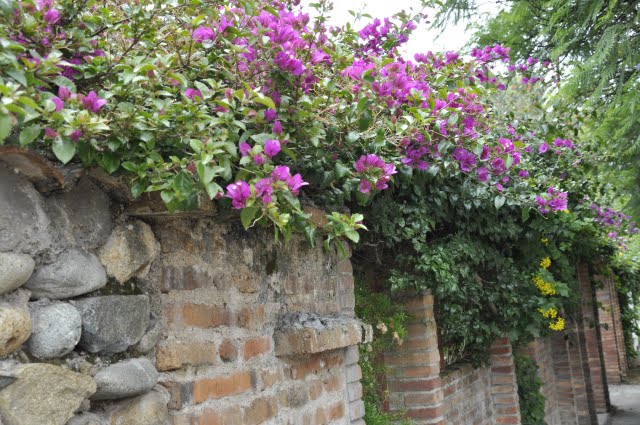
Passing many stone or brick walls with inpenatrable flowering hedges on top


At the end of our street, there is a center garden filled with numerous cactus and succulents


Then a right turn, past Santa Ines Hospital on the right and 


The University of Cuenca on the left


Another block and we will reach the river


Just before we get to the river and on the right is the entrance to the La Esquina Plaza which must be investigated by Loretta


Inside the art plaza are a couple of dozen very upscale botique shops reminicent of San Francisco or Sante Fe


Then another right turn down Avenida 12 de Abril, paraleling the River Tomebamba. Notice the cobblestones 


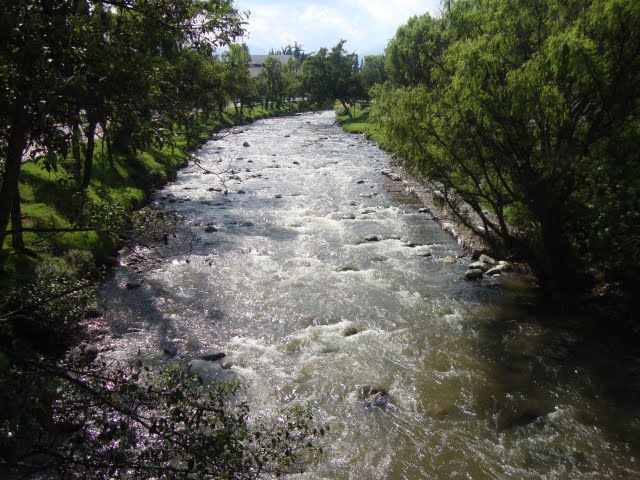
It is impossible for us to get past the river without Jonny stopping to toss a few rocks into the rapids. 


About a two block walk along the river to the bridge. At the end of the street you can see the Banco Pichincha main building.


There he goes again racing for the bridge


We made it past the ice cream vendors with a promise of a Sundae at the park


A view up river from the bridge


Nobody runs up these steps but a five year old


Fifty steps up don't look like much but at this altitude a pause to catch your breath on the landing is not a bad idea. 


At the top of the steps, we are in Centro. Notice the red tile sidewalk. 


Then we have a two block walk up Benigno Malo along many small mom and pop stores. 


Finally, Parque Calderon which is surrounded by two major cathedrals, banks, restaurants and ice cream parlors. 


One of the entrances to the park


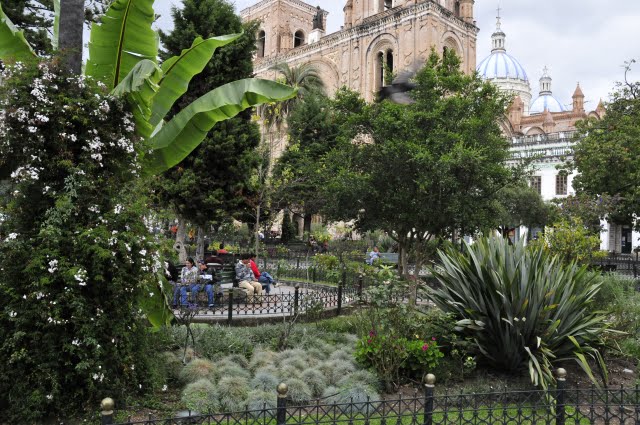
The New Cathedral which is massive inside. Usually every bench is occupied as all the parks in Cuenca are heavily used and a tremendous draw for old and young alike. 


You can see why people love the park. It is lush with tropical plants and trees and almost perfectly laid out for wandering in and out on the tiled paths and to meet friends. 


Another entrance to the park. Most of these photos were taken on a Monday holiday, Cuenca's birthday, and there were very few people in town which is usually crowded. But, it made the scenery easier to see. Now, we have to fulfill our promise of an ice cream sundae before walking back home. 

Monday, March 22, 2010

Cuenca, the clean city

One of the interesting things you will find as you wander around the streets of Cuenca, other than the fact that it is an absolutely beautiful city, is that the infrastructure is sometimes confusing and often exasperating.  One way streets, one way bridge crossings over the rivers, cobblestone streets, lack of street signs, and horrendous traffic are some of the emotional and actual obstacles that drivers and walkers must learn. On the up side, Cuenca is one of the cleanest cities you will ever encounter. Yes, there is a lot of pollution from the diesel engines of the busses and trucks. Fortunately, the wind blows the exhaust fumes away and the sky is usually crystal clear. Probably the most effective of the city wide systems to keep the city clean are the little green men and women who never seem to stop sweeping and cleaning the streets. In teams of three or four, they push their carts along the streets constantly sweeping up trash. Bagged garbage isn’t just put by the side of the road, it is placed in raised brackets high off the ground so roaming dogs don’t get to them.  Cuenca has just instituted a garbage recycling program with stiff fines for infractions. Recycled paper and plastic must be put in blue plastic bags. The only problem is that the Supermaxi markets can’t keep the blue bags in stock. But that will change once the pipe line is full.
Modern garbage trucks come on scheduled days but seem to never stop. They just keep rolling along while the workers hop on and off. Usually there will be four workers hanging onto the back. When they approach some bags of garbage, the one on the left jumps off the moving truck, grabs the bag, tosses it into the back and leaps back onto the truck on the far right side. The others move over one place so the next person is ready to jump off at the next location. Then there is the grass on the avenue’s center strips and in the parks that is kept trimmed and well manicured at all times. You will probably never see a lawnmower in Ecuador as the grass is cut by men wielding large, gasoline powered weed whackers that they swing back and forth cutting the grass to within an inch of the ground. The men work in teams and once the grass is cut they rake it up into piles and haul it away.  An interesting side light is that cattle often are put by their owners in the center strip or the sides of the road to eat the green grass.  Actually, this isn’t a bad idea as the cows keep the amazingly fast growing grass in check.

Although it really doesn’t help keeping the grass cut, you will often see people at the side of the road cutting what looks like grass or weeds but are actually edible herbs and grasses that they sell in the markets and on the street corners. We constantly hear the comment that Cuenca is one of the cleanest cities people have ever seen. The cars and busses are clean. The streets are clean. The people wear clean clothes. The city is manicured. It looks like hard work but the city government is committed to making it so and it rubs off onto the population. 


Tuesday, March 9, 2010

Is Ecuador right for me?


A few years ago I wrote an article for a magazine on the decision making process. Little did we know at the time that we would soon begin the process of trying to find the right place to retire where we would put every decision making concept that I had written about to the ultimate test. Almost every expat or potential expat we have spoken to has made a similar journalistic journey and done an enormous amount of research prior to moving from the US, Canada, or Europe. In every case once the germ of the idea took root - the idea of moving abroad - the search started in earnest. With few exceptions, searching on the internet through websites and blogs is where the decision process began for all of us. We researched Mexico, Costa Rica, Panama, Italy, India, and found enough negatives to eliminate them. In the long run, Ecuador is where we found the most desirable qualities to fit our need for living well affordably. The search then began to get deadly serious. We brainstormed on paper with arrows running in a hundred different directions. What town is the best? What is the right part of that town? A house or apartment? Rent or buy? What is the true cost of living? Are there English speaking people? Will we be able to buy what we need there? Will our four year old grandson get a good education? What are the consequences of leaving the US that we had known all our lives and relocating to a foreign country? These questions were put down on paper along with the solutions that we found, plus endless lists of additional questions that required more up-to-date answers. But, who knew these answers? Where could we find them? We asked specific questions via emails and got good answers from expats living in Ecuador. We found more and more websites and blogs as we narrowed our choices. We then put the decision to move to Ecuador into action by planning an extended visit to Ecuador. We still believe that a visit is the most important step of all. We knew that we would not be comfortable on the coast though we love the ocean so our trip concentrated on the Sierra - Quito and Cuenca – and we visited both extensively.  One of the concepts of decision making is that a person often has to make decisions quickly without enough time to really look as deeply as you would like.  Experts advise in these situations that you keep your eye on the goal and then let your intuition make the right choice. We did just that. We saw a house we loved in Cuenca and, on the last day of a three week visit, put a deposit down to purchase. It had been a two year long decision making process but, in that moment of resolution, we knew we had done the right thing.  There is no way to give another person all the answers to the questions that dwell in their minds but most of us are here to help if at all possible. We look forward to meeting new friends and sharing our experiences, good and bad.  There are a thousand steps along the way that each person has to ascend, a thousand decisions, big and small, that must be made that lead to a final choice each will make. With all that said, the second best advice we can give is to not make it a tedious enterprise but make it a fun process and enjoy the ride.  

Wednesday, February 24, 2010

Things we don’t miss about the USA


Dirty streets – Streets in cities where we have lived in the US are almost universally full of trash. Often, there were $200 fines for littering but it didn’t seem to make much difference. Litter was everywhere. Some people were audacious enough to dump bags of trash along the roadside just to get rid of them. Here the streets are spotlessly clean. Trash and garbage are efficiently picked up daily by teams of little green men and women.

Interstate highways –We often think of the monotony of driving along miles and miles of Interstate highway dodging speeding trucks, long delays sitting in traffic jams and the rest stops filled with junk food and dirty, crowded bathrooms versus our decent country roads with an occasional interesting restaurant and an adventure around every corner.

Homeless people – we have yet to see a truly homeless person here in Ecuador. In Philadelphia there are homeless on nearly every downtown street. In the winter they sat on steam vents to keep warm. They were everywhere, sleeping on the sidewalk, rifling through dumpsters and trash cans, or wheeling their possessions along the street in stolen shopping carts. It was something we never really got used to.

Dumpsters – We have never seen one in Ecuador.

High cost of living – gasoline at a stable $1.48 not $2-3.00 plus a gallon like in the US, heating oil is not necessary, air conditioning is not necessary, food, especially fresh food, is very inexpensive. Private schools are $3-4000 per year not $10-12,000 as in the US. Home costs and rental apartments are quite inexpensive.

Aggressive sales people – The Ecuadorian sales clerk has not yet learned to be aggressive and you must often seek them out in order to buy something. The hard sell found on TV, newspapers and magazines is but a quarter of what you would find in the US.

Junk mail – Our mailbox used to almost overflow with junk mail every day in North Carolina. Most was never read but just ended up in our trash can. We rarely receive mail in Cuenca, only an occasional utility receipt or bank statement as mail is not a common way to communicate.

Doctor’s offices – We remember the long waits in the doctor’s office in the States even though we had an appointment while he fell farther and farther behind as the day progressed. Then the visit lasted only a few minutes. Contrast that with a visit to the doctor here. It is a first come, first serve, walk-in system. Surprisingly, the doctor will spend a long time talking to you as he asks probing questions. The doctor is usually alone and does everything from diagnosis to treatment to collecting his fee. 

Violent weather – We remember hard, cold winters and oppressively hot summers that were costly to tame and often gave us an edge-of-the-chair storm or two each season. Cuenca’s weather is the same spring like climate all year long and is never violent.

Industrial pollution – There are no tan skies filled with smog as you will find in the industrial cities of the north. We must admit, however, that the diesel truck and bus exhaust is terrible. Fortunately, Cuenca’s high location and facing position lets the wind keep the air clear and pollution free.

Insects – Having come from North Carolina where the mosquitoes and ants seem to be taking over, our bug free climate is a welcome relief. We have no screens on our windows in Cuenca though this would not be true in the Amazon region or on the coast.  Freedom from bugs is a real plus here in the Sierra.

Junk food – It is relatively easy to buy familiar junk food in the supermarkets here but it is sold side by side with healthy and often organic food which does not carry an escalated price as in the States. Fresh fruit, vegetables, meat and fish are available everywhere.

Restaurants – Unlike the US, it is almost as inexpensive to eat out in a restaurant as it is to cook at home.

Seasons – Believe it or not, we don’t miss the lack of seasonal change as much as we thought we would. It is now February, 70 degrees and sunny, and the news is full of the worst winter snow storms of the century that have hit the east coast.

Daylight savings time – It was always stressful in the north with winter’s early darkness, waking in the morning to a pitch black sky, kids leaving for school in the dark in the morning and coming home in the dark in the afternoon, and the twice a year project of time adjustment when you had to change every clock in the house and car. But here in Ecuador, there is no daylight savings time and no change in the amount of day or night. Daylight Savings time isn’t necessary as the days are always about 12 hours long and the nights the same.

Lawyers – In the US, there was barely a function left that didn’t require the expertise of a lawyer and we always felt vulnerable if we didn’t seek their advice.  Many of the same legal problems exist in Ecuador but they are not as expensive to execute or as pervasive. It is not a litigious society possibly because legal matters take a long time to resolve and, therefore, are not as appealing to begin.

Saturday, January 23, 2010

Exercise in Cuenca


Another question we had prior to coming to Cuenca was if there was a good gym where we could exercise. A gym didn’t seem necessary with all the walking we do but exercise at a gym was a real habit with us. Cuenca is a city of hills, steep steps and is located at about 8000 feet elevation. All this tends to make even walking a pretty strenuous activity. When we first arrived we were concerned about altitude sickness and even had our North Carolina physician prescribe medication to prevent a reaction to living at a high altitude. This was totally unnecessary as we acclimated almost immediately, even when we stayed in Quito which is at about 10,000 feet. However, more strenuous exercise than walking takes a while to get used to. Running or climbing the 50 steps up to the city or even hiking in the mountains, makes even the most fit person, stop to catch their breath. After living at sea level for almost all of our lives, the altitude in Cuenca took a little getting used to when we exercise. Even though normal walking or working around the apartment doesn’t bother us, strenuous exercise like climbing the steps to the city requires a stop to recover. So, we decided to try to find a gym. There is no such thing as the huge Gold’s Gym or its equivalent in Cuenca. Most gyms are small and have quite antiquated equipment. The gym at the University of Cuenca, which you would expect to be quite elaborate, appears almost dangerous. The equipment is old and in bad repair. After much inquiry and a lot of looking, we found, what we think is the best in Cuenca.


It is called Cam Gym and is located in the newer section of town just off Avenida Remigio Crispo. There are many others located all over the city but Cam Gym has fairly new equipment, a trainer, is clean and is in good repair. Tai kwon do and dance are taught upstairs. Tai kwon do is a very popular activity for children of all ages and the gym creates many champions while the children are still in grade school.  Because almost everything is within walking distance, we and most of our friends enjoy  and  go walking a great deal more than when we lived in the suburbs of the US. It has to be healthy, even though it is tough going sometimes, and, along with going to the gym three times a week, we feel in the best shape we have been in years.

Wednesday, January 20, 2010

Map of City of Cuenca

It is difficult to find a good map of Cuenca. Cuenca Real Estate probably has the best one. However, none of them tell you where specific places of interest to Gringo's are located. We have marked up a very simple map of the city with approximate locations of places you will undoubtedly go to when you are here. You can see by the map that the city is divided almost in half by the River Tomebamba. On the north side is the old city or Centro where much of the cities infrastructure exists, like churches, parks, stores, businesses, government buildings, lawyers, and restaurants and, of course much more. On the south side of the river are the newer suburbs where you will find the Futbol stadium, many restaurants and stores, the large mercado, two of the Supermaxis, and most of the 5 plus story apartment buildings. Circling the city are the Avenida de las Americas on the north and the Autopista on the south. To see a larger view of the map, double click on the map


Here are some of the actual addresses:
Zoe's restaurant (expat meetings) – Borerro y Sucre
Eucalyptus restaurant (expat meetings) – Gran Columbia y Benigno Malo
Supermaxi El Gal – Avenida Cordero y Jose Peralta
Supermaxi/Sukasa (upscale department store) – just above Gran Columbia y Avenida de las Americas
Supermaxi/Kywi (best hardware store) – Avenida Turuhuaico y Gil Ramirez Davalos
Del Rio Mall – Autopista in South west corner of city
Main Mercado El Arinal– Avenida de las Americas y Remigio Crispo
Cooperia (food coop) – Victor Manual Albornoz near Avenida de las Americas
Collisium (Tennis courts) – Avenida 12 de Abril y Unidad Nacional
Post Office – Gran Columbia y Borerro
Bank of Pichincha – 12 de Abril y Solano
Cam Gym (largest in city) – Nicolas Sojos y Gonzalo Cordero

Tuesday, January 12, 2010

Flowers in Winter


It is probably not kind to rub it in when the US and Europe are having such a hard winter but, with your indulgence, we'd like to show you some photos of Winter in Cuenca. Today is January 12th and it is around 65 degrees and cloudy. Flowers are in bloom everywhere. Some we have seen before. Others are new to us but just as beautiful. If you know the names of the more unusual and would like to share them, we'd appreciate it.


This is a hedge growing on the wall next to our aprartment


Daisys never stop growing


This thick hedge grows on top of a wall and is absolutely impenetrable.


Flowering pink tree


Up close shot of the flowers on the pink tree


Another impenetrable hedge growing on a stone wall


Bottle flower?


You have to see this to believe it


Growing over a wall


Huge shrub or tree with enormous yellow flowers


These flowers are about 5 inches across


No flowers are more well known than the roses in Ecuador. $2 for 18 long stem roses at the flower markets.


There are times of the year when the trees are completely covered with these purple flowers and no leaves.


We have seen these in California but here they grow almost wild.


And the best for last.