A New Kind of Blog

There is a world of information about Ecuador. It is one of the most popular countries for people who want to retire to a place where the dollar goes much farther than in the US, a place for adventuresome families who want to experience a new language and exciting culture. However, much of what you read or hear does not touch on the practical, the problematic, or the local information necessary to make things work. There are many blogs which are basically daily diary’s from people who live here. But this blog will be different. We know how hard it is to get accurate and timely information. We have been through it. All of us who live here have learned step by step and we question whether it is necessary to have every newcomer reinvent the wheel. We hope this blog will help shorten the learning curve. There are many hurdles but all are surmountable. What is required is patience, an understanding of local ways, and a realization that you are going to live in a country which is not the same as the US, Canada, or Britain. Our choice was to live in the wonderful city of Cuenca in the Southern Sierra but this may not be your decision and you will therefore have to look further to find the answers you need for different areas like the coast or the Amazon. Please realize that all the suggestions and ideas are based on our experiences. Ecuadorian regulations change rapidly and must be checked before you make any investments or major decisions. Please email us at Sailorburr@gmail.com and let us know if you have any questions or comments.
Showing posts with label Food. Show all posts

Sunday, March 14, 2010

The Fruits of Ecuador


Along with all the more common fruits you are used to plus papaya, kiwi, melons, and passion fruit, the markets in Ecuador are filled with exotic fruits you may never have seen before. After opening, deseeding and sometimes skinning, most can be made into exceptional fresh juices (jugos) using a blender, juicer or citrus juicer.

Mora (Blackberry) Ecuadorian blackberries are different from those you’re used to as they are larger and more tart. The blackberry bushes grow like weeds in most parts of the country. Although they can be eaten right off the vine, generally Ecuadorians blend them with water and add a little sugar for an excellent juice.


Tomate (Tree Tomato) The tree tomato is a red, egg-shaped fruit full of pulp-covered seeds 
somewhat  like passion fruit. They are called  tomatoes because their reddish color is a like a tomato and the juice made from the seeds tastes vaguely like a tomato. Tree tomatoes are good for juice or for boiling in sugar for a dessert treat but they are too sour to eat fresh.


Taxo (Banana Passionfruit) is an elongated, soft  fruit that looks a little like a small, straight, orange banana. Inside of the fruit, there are dozens of seeds covered in pulp which you remove from the seeds. The pulp is used to make juice or ice cream. The skin is discarded. Taxos have a tangy, tart taste, and although they can be eaten fresh, they rarely are. In shops, where they make handmade ice cream, the taxo is a popular flavor.


GuanĂ¡bana (Soursop) The GuanĂ¡bana is a green fruit with a rough outer skin. They can get quite large, some reaching the size of a soccer ball. Inside the green skin, the fruit is white and pulpy and full of many seeds, each of which is about the size of a cherry. This white flesh can be eaten fresh and tastes vaguely of strawberry. It is very sweet and mild. Because it is messy to eat and the seeds are annoying, Ecuadorians prefer to make juice out of them.


Naranjilla (Little Orange) are a round, bright orange fruit a little smaller than a tennis ball. The inside is full of tiny seeds and pulp. The pulp is scooped out and blended, strained and sweetened  to make a greenish-orange, tangy juice that has an interesting perfume-like aftertaste. The naranjilla is native to Ecuador and Colombia and rarely grown elsewhere.


Granadilla (Sweet Granadilla): Referred to as passion fruit in some parts of the world, granadillas are small, pale orange-pink, egg-shaped fruit. The outer shell of the fruit cracks open to expose the fruit inside which consists of dozens of black seeds enclosed in a semi-transparent gray pulp. The seeds and pulp are eaten whole and the cracked skin is discarded. Granadillas have a very mild, fruity flavor. They are generally eaten fresh and raw as they are far too mild for juice.
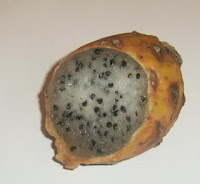


Pitahaya (Dragon Fruit): Ecuadorian pitahayas are bumpy yellow fruit that grow on a local species of tree cactus. The skin is cut open to reveal the pulp which is semi-transparent, grayish and full of tiny black seeds. Eating one is a little like eating a kiwi. The fruit is sweet and mild and is usually eaten raw and fresh although it also makes good juice. It has mild laxative properties.


Uvilla (Ground Cherry, Gooseberry): These small yellow fruits are called ground cherries because they grow close to the ground and are roughly cherry-like in size and shape. They have nothing in common with cherries, including taste and there is no stone. They are bright yellow and grow inside a husk that looks like a paper lantern. The flavor is a somewhat  like pineapple and they are eaten raw and fresh, one after another, like popcorn.


Tuna (Prickly Pear): Not to be confused with the fish, the tuna is the fruit of a species of cactus. The fruit even looks like a small cactus. The outer green skin is cut open to reveal the red pulp inside. There are small, crunchy seeds that are tasteless and can be eaten. The fruit itself has a very mild flavor and is fairly bland.


Orito (Finger Banana): Ecuador is famed for the varieties of bananas it produces. One favorite is the Orito,a small banana, about half the size of the ones destined for export. Oritos are sweeter and have a slightly richer taste than the bananas sent abroad.


If you prefer you can buy many of the above as fresh, squeezed pulp in plastic bags at almost any market. 


Oranges: Throughout the world there are 97 varieties of oranges. In Ecuador a few of these varieties are grown everywhere and make wonderful fresh juice. The large oranges have no seeds but are less sweet. The small oranges are full of seeds but are very sweet. We mix them together to make our morning orange juice.

It takes a little experimenting to know the right amount of sweetener to add to the pulp of the more exotic fruits to create a juice that you will enjoy. But after trying them one by one they open up a whole new source of pleasure and good nutrition.

Saturday, January 2, 2010

Food


In Ecuador there are many fruits and vegetables most northerners have never seen before. We are not sure we can do them justice by introducing them to you in our blog but we’ll give it a try. 
Most of the following are available at Supermaxi, the Cooperia, the mercados, or from the wheelbarrow merchants that prowl the streets of Cuenca. First of all, fruits and vegetables are probably the least expensive things you can eat. A vegetarian has a real fiscal advantage here. Second, though we realize there are growing patterns, it seems as if strawberries or lettuce or almost any other kind of produce is available all year long. There doesn’t seem to be a season for anything, they are almost always sitting there in the market. It would be hard not to find everything you are used to plus dozens you have not seen before. Supermaxi sells bags of juice made from tomate, Guanabana, coco, maracuya, marianjilla, mango and guyaba. All you need do is add some water, put it in the mixer with a little sugar to take the tartness away and you have a great drink. You will see from the following that having a juicer and blender is essential to take advantage of the usual and the unusual.
All the more conventional stuff is available, Mangos big and small are excellent, watermellon, cantelope, black berries, strawberries, grapes (though most have seeds), lettuce, carrots (unusually fat and short), cucumbers, potatoes, spinach, and on and on. Avacados are everywhere and excellent when they get very ripe so they are completely  soft.  There must be a half dozen varieties of oranges which we buy by the dozen a few times a week and squeeze every morning for fresh orange juice.
But, it is the unusual that keeps you staring and wondering what to do with such an exotic creature.


One of the most popular is the tomate, a tomato like fruit that, when juiced, makes a wonderful drink.


Then, of course, you can buy bagged fruit pulp and make your own special juice.


You could probably exist on bananas in Cuenca. They are dirt cheap and delicious. Many varieties.


Just a few unusual fruits at Supermaxi. Mango, Durazano, Chirimoya, Taxo, and Pepino Dulce.


This is at the Cooperia, a tray full of Tuna and Dulce.


Two kinds of Papaya at the Cooperia. There are at least five rows of shelves filled with every fruit and vegetable grown in Ecuador.


A tray full of mangos, so sweet they are almost sinful.

We hope that this little photographic tour of the exotic fruits of Ecuador has whet your appetite. We are slowly learning how each one of them are best prepared but it is confusing when you stare at something totally foreign and try to decipher how to get at its core. There have been a lot of trial and errors as we struggled with  pulp difficult to separate from pits and super tartness here and there, but each time we try something new, we find out a little more. Our diet has changed enormously and we find ourselves eating fruit instead of sweets. Can't be all bad.

Saturday, December 5, 2009

Eating in Ecuador


One of the most interesting subjects about Ecuador is the wonderful food. The mid-day meal is the big meal of the day followed by a light dinner. Many businesses and retail establishments close from one to three in the afternoon when most people go home for the main meal of the day. Restaurants open early but are never full until at least nine PM. It is not unusual to see a table full of an entire family, grandmother and grandfather, mother and father, cousins and children, even small children, eating supper that will last up to 10 or 11 at night. To buy food for your own cooking, there is a large supermarket chain in Ecuador called Supermaxi who have three stores in Cuenca. This is far fewer than you may be accustomed to but Supermaxi has almost everything you might want. A couple of notable exceptions are that there are very few frozen foods and almost no prepared food. Also fresh orange juice in cartons like Tropicana is expensive at around $6.00 per quart as everything imported carries a high protective tariff. Oranges and most fruits are very inexpensive. Most people squeeze their own OJ using an Oster juicer. You will have to get used to the food packaging in Ecuador as some of it is very unusual. Milk comes either raw and is delivered from buckets by truck to your door, or fresh pasteurized milk in one liter, plastic bags at the markets which have to be cut open and poured into a jug to keep in the refrigerator, or irradiated milk in one liter boxes that you keep un-refrigerated in the pantry until you need it. The wine we drink is quite good at about $5.50 per liter. It comes from Chile and is also in plastic boxes. Hamburger meat has very little fat. We buy 1% fat content ground beef at about $2.50 per pound. The produce counter is the most fun with dozens of unusual fruits and vegetables, too many to name. At the market you will find imported products like Ritz crackers alongside a locally made imitation that will be half the price. It takes a little investigation to find what the good local products are but the savings can be large. Mini-markets are on almost every block where you can get basic staples. Cuenca has an incredible co-op called Coopera which sells fresh fruit and vegetables many of which you have never seen before at extremely reasonable prices. Yesterday, $13 bought us a cantaloupe, a head of lettuce, a cucumber, a pound of white grapes, a pound of huge strawberries, four fat carrots, a half dozen tangerines, two mangos, a dozen peaches, a dozen tomatoes and a dozen large juice oranges. At a nearby flower shop, another $5 bought 18 long stem white roses, 12 white carnations and 12 stalks of Baby’s Breath. We keep fresh flowers in vases around the apartment almost all the time. In the city, vendors push wheelbarrows full of huge strawberries, oranges and tangerines that are some of the best you can find anywhere. There are three huge Mercado’s with hundreds of stalls where Indians sell farm raised fruit, vegetables, meats (mostly un-refrigerated), and live animals like chickens, guinea pig, dogs and cats. We sometimes shop there when we are looking for some unusual produce but the Mercado’s are somewhat risky places for gringos. Unfortunately, the indigenous Indian diet of boiled rice and fried chicken causes a lot of obesity and the poorer children are lacking in milk which stunts their growth. All in All, our food purchases and restaurant experiences have been excellent. There are hundreds, maybe thousands of restaurants, only a few dozen of which we have gone to. Most have been great. As an example, a very high end restaurant called Quatros Rios serves an excellent dinner comparable to any you might find in the best US restaurants at about $10 per person. There are restaurants at every price range down to a Tipico at $1.50. Everyone has their favorites. A number of them are in old Spanish hotels where the restaurant is in an indoor hacienda-like, courtyard. There are Chinese, Indian, Italian, and most other cuisines available.


 It is a little adventuresome, but we have gone many times to “Comida Tipicos,” or restaurants that mostly cater to the working class. A bowl of delicious soup followed by a plate of rice and chicken and a fruit drink costs about $1.50. Then there are the roadside roasted pig food sellers. The pig is suspended on a spit. Skinned, roasted and hacked at day after day, they are popular with the locals who stop and buy a pig sandwich. Unrefrigerated for days at a time, this can be risky business for a gringo. Guinea Pig is a local delicacy. Called Cuy, these cute little creatures are an even larger obstacle for Americans who know them only as pets. Eating Cuy seems to be a national pastime and, believe it or not, they are quite delicious. We tend to only eat out a few nights a week because of our four year old grandson, but most of our friends eat out nearly every night. The enormous variety and the low cost, makes it hard to avoid eating out as often as possible.